10/06/2026
5 mins
Three sessions, 100+ brains: what the LUCID preprint found

Juliet Sharkey
In June 2026 we published the first results from LUCID, our longitudinal study with Imperial College London, as a preprint on bioRxiv. It is the research behind every metric Connectome reports. This is what it found, in plain English, with the numbers that matter and the limits that come with them. This research is a preprint and has not yet been peer reviewed.
The study
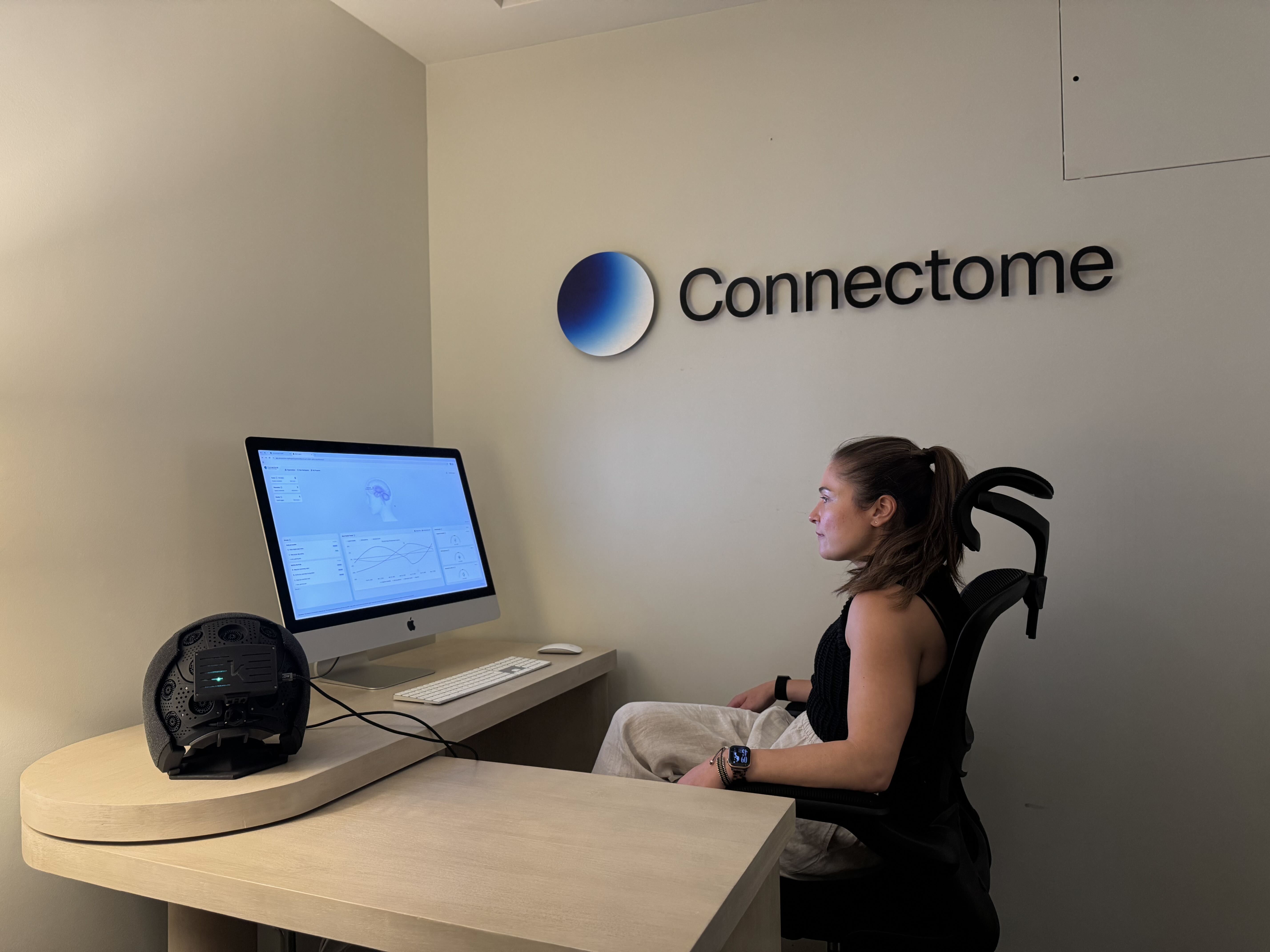
Ninety-two healthy adults, aged 18 to 55, completed three sessions at our London studio, roughly seven to ten days apart. At each session they wore a time-domain fNIRS headset (the Kernel Flow2) measuring activity in the dorsolateral prefrontal cortex while completing a fixed battery of cognitive tasks: immediate and delayed object recall, digit span, a 2-back working-memory task and a Stroop rule-switching task. Alongside, each participant's consumer wearable supplied around a month of sleep and physical-activity data.
The paper is titled "Prefrontal activation predicts response latency and is shaped by age and lifestyle". Its authors are Rufus Mitchell-Heggs, Daniel Tamkin, Lucas Scherdel, Anita Snowdon-Farrell, Alfred Curry, Onayomi Rosenior-Patten and Simon R. Schultz.
Finding one: the brain measure tracks performance
Across the working-memory and rule-switching tasks, in both hemispheres, greater prefrontal activation was linked to faster responses. The correlations ranged from about -0.37 to -0.53 and were all highly significant. The link was strongest during the rule-switching trials of the Stroop task.
Why it matters: it means the signal we measure from the brain is doing something. It isn't just activity; it relates to how well the task got done. That is what makes the relationship between brain effort and task output a meaningful thing to track over time.
Finding two: your brain response has a stable signature
For every measure, the differences between people were larger than the variation within a person across sessions. Reliability ranged from ICC 0.56 to 0.77. The most reliable measures were the prefrontal composites from the Stroop task, where between-person differences were about three times the within-person variation (ICC 0.75), and combining both hemispheres beat either alone.
Why it matters: a measurement you intend to track has to be stable enough that a change means something. These numbers are the case for a personal baseline, and they tell us which metrics to trust most when reading change.
Finding three: age first, then lifestyle
Age was the strongest predictor of prefrontal activation. Sleep and physical activity each added independent information on top, modest in size (roughly one to two percent of additional explained variance in the models), but real and non-redundant.
Why it matters: the lifestyle signal exists, it's personal, and it's small enough that you need repeated individual measurement to see it. That is the design brief for Lifestyle Links.
What didn't hold
The study also tested a laterality index, the balance of activation between left and right dlPFC. It was not stable within a person (ICC 0.21), so it is not something we report. Publishing the measures that failed is part of the point.
The limits
One study, 92 healthy adults, one city. The findings are associations within that cohort, not causal claims and not clinical ones. LUCID does not show that these measures diagnose anything, predict health outcomes or tell anyone what to change. The next study, with adults who have an ADHD diagnosis, asks whether the same measures behave the same way in a different population.
Read the preprint on bioRxiv: https://www.biorxiv.org/content/10.64898/2026.06.22.733821v1
The measures are not intended for diagnostic use. The normative values applied are preliminary, not gender- or age-specific, and should be interpreted with caution. Connectome measures cognitive performance, not pathology, and does not diagnose, predict or prescribe. Measured with the Kernel Flow2: Class 1 laser, FLPPS 21CFR1040.10, For Research Use Only. Research with Imperial College London (LUCID) is a preprint and has not yet been peer reviewed.
Partner with confidence
If you’re exploring how cognitive intelligence can support performance, health, and decision-making across your organisation, we’d love to talk.

Partner with confidence
If you’re exploring how cognitive intelligence can support performance, health, and decision-making across your organisation, we’d love to talk.
Partner with confidence
If you’re exploring how cognitive intelligence can support performance, health, and decision-making across your organisation, we’d love to talk.
10/06/2026
5 mins
Three sessions, 100+ brains: what the LUCID preprint found
Juliet Sharkey
In June 2026 we published the first results from LUCID, our longitudinal study with Imperial College London, as a preprint on bioRxiv. It is the research behind every metric Connectome reports. This is what it found, in plain English, with the numbers that matter and the limits that come with them. This research is a preprint and has not yet been peer reviewed.
The study
Ninety-two healthy adults, aged 18 to 55, completed three sessions at our London studio, roughly seven to ten days apart. At each session they wore a time-domain fNIRS headset (the Kernel Flow2) measuring activity in the dorsolateral prefrontal cortex while completing a fixed battery of cognitive tasks: immediate and delayed object recall, digit span, a 2-back working-memory task and a Stroop rule-switching task. Alongside, each participant's consumer wearable supplied around a month of sleep and physical-activity data.
The paper is titled "Prefrontal activation predicts response latency and is shaped by age and lifestyle". Its authors are Rufus Mitchell-Heggs, Daniel Tamkin, Lucas Scherdel, Anita Snowdon-Farrell, Alfred Curry, Onayomi Rosenior-Patten and Simon R. Schultz.
Finding one: the brain measure tracks performance
Across the working-memory and rule-switching tasks, in both hemispheres, greater prefrontal activation was linked to faster responses. The correlations ranged from about -0.37 to -0.53 and were all highly significant. The link was strongest during the rule-switching trials of the Stroop task.
Why it matters: it means the signal we measure from the brain is doing something. It isn't just activity; it relates to how well the task got done. That is what makes the relationship between brain effort and task output a meaningful thing to track over time.
Finding two: your brain response has a stable signature
For every measure, the differences between people were larger than the variation within a person across sessions. Reliability ranged from ICC 0.56 to 0.77. The most reliable measures were the prefrontal composites from the Stroop task, where between-person differences were about three times the within-person variation (ICC 0.75), and combining both hemispheres beat either alone.
Why it matters: a measurement you intend to track has to be stable enough that a change means something. These numbers are the case for a personal baseline, and they tell us which metrics to trust most when reading change.
Finding three: age first, then lifestyle
Age was the strongest predictor of prefrontal activation. Sleep and physical activity each added independent information on top, modest in size (roughly one to two percent of additional explained variance in the models), but real and non-redundant.
Why it matters: the lifestyle signal exists, it's personal, and it's small enough that you need repeated individual measurement to see it. That is the design brief for Lifestyle Links.
What didn't hold
The study also tested a laterality index, the balance of activation between left and right dlPFC. It was not stable within a person (ICC 0.21), so it is not something we report. Publishing the measures that failed is part of the point.
The limits
One study, 92 healthy adults, one city. The findings are associations within that cohort, not causal claims and not clinical ones. LUCID does not show that these measures diagnose anything, predict health outcomes or tell anyone what to change. The next study, with adults who have an ADHD diagnosis, asks whether the same measures behave the same way in a different population.
Read the preprint on bioRxiv: https://www.biorxiv.org/content/10.64898/2026.06.22.733821v1
The measures are not intended for diagnostic use. The normative values applied are preliminary, not gender- or age-specific, and should be interpreted with caution. Connectome measures cognitive performance, not pathology, and does not diagnose, predict or prescribe. Measured with the Kernel Flow2: Class 1 laser, FLPPS 21CFR1040.10, For Research Use Only. Research with Imperial College London (LUCID) is a preprint and has not yet been peer reviewed.
Partner with confidence
If you’re exploring how cognitive intelligence can support performance, health, and decision-making across your organisation, we’d love to talk.
Partner with confidence
If you’re exploring how cognitive intelligence can support performance, health, and decision-making across your organisation, we’d love to talk.
Partner with confidence
If you’re exploring how cognitive intelligence can support performance, health, and decision-making across your organisation, we’d love to talk.