06/10/2026
12 mins
Introducing the Brain Profile: a fingerprint of your unique brain

Juliet Sharkey
Our biggest update yet. A profile that learns you with every scan, Lifestyle Links that show what your brain is linked to, and the Connectome app with a weekly score between visits.
Everything else you track measures your body. Connectome measures your mind. Today we are releasing the Brain Profile: a ten-minute measurement that learns you with every scan, reads your lifestyle against every result, and shows which parts of your life your brain is most strongly linked to, so you know where to focus.
It is built on the same measurement we validated with Imperial College London, and it changes what you get back from every scan. Your results are now read against your own usual range rather than everyone else’s. Your wearable data finally says something about your brain. And a new app keeps the picture live between visits. Whether you scan for yourself at our Soho studio or run a programme for your athletes or clients, the profile works the same way.
“HRV and VO2 max exist for the cardiovascular system. DEXA scans measure muscle mass. Now brain measurement is possible too, and you can’t take care of what you can’t clearly see or reliably measure.”
Lucas Scherdel, Co-founder and CEO, Connectome
Your profile home: each metric today against your own usual range, the region measured, and Lifestyle Links by factor or by brain response.
A profile of you, not a comparison to average
The first question anyone asks about a brain result is “is that good?”. Until now the answer came from a range built from everyone we have measured. From your second scan, it comes from you.
Your usual range is the band your own brain response normally sits in, built from your own scans and tightened with every visit. Each new result lands within it, above it, or below it, and gets a plain-language read: a normal day, generally favourable, or worth a look at what it is linked to. About one scan in three lands outside by design. That is what a range is, not a verdict.
That means a result you can read in one glance, without a norm table. Scan one gives you a starting range. Scan two makes the profile yours. Every scan after that makes it more yours, and every past result keeps the range it was read against at the time, so nothing is re-judged later.

Domains today: each metric against your usual range, with a plain-language read and the trend.
For teams and clinics: every athlete or client is read only against themselves, never against a norm table or each other. A real dip and a bad morning look different before the meeting rather than after the result.
Four metrics from every scan, now with neural efficiency
During a ten-minute scan you complete two short tasks in a headset while the device records how the dorsolateral prefrontal cortex, the part of the brain that plans, focuses and decides, responds. Four metrics come out of it.
Attentional control. Keeping attention where it needs to be and filtering out what does not matter. This is the roll-up metric, so it sits at the top of your profile.
Working memory. Holding information in mind while you use it: the phone number, the plan, the argument you are halfway through making.
Cognitive flexibility. Switching between tasks effectively and making decisions under pressure when the situation changes.
Neural efficiency. New in this release. How hard your brain worked for the result, against your own spread. Two people can post the same score while one cruises and one redlines; this is the metric that tells them apart.
That means you see not just how you did, but how your brain got there. Each metric is shown as a brain response with its own range, next to the task performance it came from, so you can see when the two agree and when they do not.

This scan: brain response, task performance and neural efficiency, each against your own range.
Coming soon: cognitive readiness. A further metric is in development and will be added to your profile when it is ready.
Lifestyle Links: see what’s linked to your brain, and where to focus
Your ring or watch already knows how you slept, how hard your days were and how well you recovered. Until now, none of that told you anything about your mind. Lifestyle Links reads the last ninety days of your wearable data against every scan and shows which factors your brain is most strongly linked to, and by how much.
Lifestyle Links are grouped into four factors: sleep quality (deep, REM and light sleep), sleep interruptions (awake time and how continuous your sleep was), overnight recovery (breathing rate and heart-rate variability while you slept) and daily load (activity, calories burned, steps). For each you see its share, which direction it pushed, and the signal it was read from. View them by lifestyle factor or by brain response, so you can ask either “what is my sleep linked to?” or “what is my working memory linked to?”.
That means one clear place to focus. The factor most strongly linked to your brain is yours, not the average person’s. For one person it is deep sleep. For another, daily load. Your profile names yours and gives you general wellbeing suggestions for supporting it based on your own Lifestyle Links rather than generic advice: protecting deep sleep before a demanding week, say, or easing daily load when your brain is below its range. You choose what to try; your next scan shows whether it was linked to a change. Never drugs or supplements.
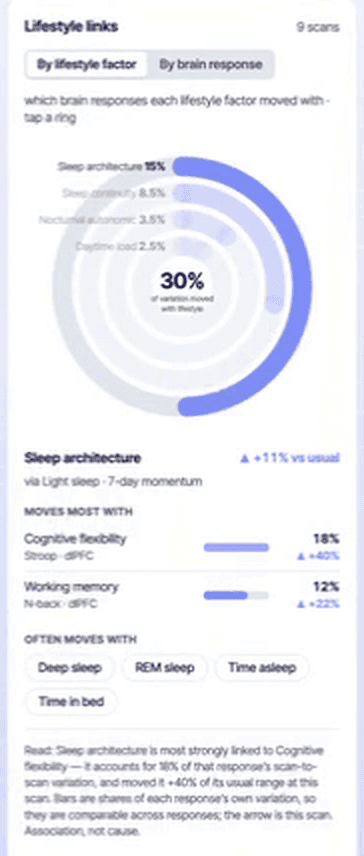
Lifestyle Links by factor: the share of your usual range each factor moved with, and the signal it was read from.

Lifestyle Links by brain response: ask “what is my working memory linked to?” instead.
Two things to keep in mind. Links are associations, not causes: they show what your brain response moved in step with, not what caused it to change. And the more consistent your wearable data, the sharper the Lifestyle Links become; about a month of steady wear is enough to begin.
For teams and clinics: one lifestyle focus per person, from their own data, rather than one recovery talk for the squad or one plan for every client. And a way to see whether it is working the next time they scan.
The Connectome app: your brain, your lifestyle, one weekly score
Scans are where the measurement happens. Between them, your lifestyle keeps moving. The Connectome app, available now, learns how your brain response is connected to your sleep and your days, and every week gives you a score that follows your lifestyle.
That means you can see whether the changes you are making are showing before your next scan, not after it. Log an Event when something is going on, watch your weekly score move with your weeks, and arrive at your next scan knowing what to look for. Your scans stay the ground truth; the app keeps your profile live in between.

The Connectome app: your brain, your lifestyle, one score.
Download the Connectome app: [App Store] · [Google Play]
For teams and clinics: every athlete or client gets the weekly score in their own app, so the lifestyle picture stays live between visits and the next scan is read with the context already in place.
Know how much to trust a result before you read it
Some scans deserve more weight than others. Every result in your profile now carries a status bar above it that answers three questions before you look at the number: how good was the scan, how much lifestyle data sits behind it, and how well does the profile know you yet.
That means no silent fallback. If a value is still being read against everyone rather than you, the status bar says so in one line and tells you what will change it. Your profile never shows you a personalised-looking number it cannot stand behind.

The status bar: scan quality, wearable coverage and how personalised your profile is, above every result.
For teams and clinics: a number you can take to a head coach, a medical director or a client knowing exactly how much weight it carries, without adding caveats of your own.
Events: log what was going on around a scan
Life gets in the way of a clean scan. A red-eye flight, a bout of illness, a brutal week, a big night. Events let you record what was happening around a scan so it is read in context.
When a scan lands beyond your range, Connectome asks one question: was something going on? Log an Event and the scan is marked as explained. That means it stays on your timeline with its reason attached, so nobody, including you, over-reads it later. You supply the context; the profile never guesses it, and it never attributes a scan to a cause.
Your timeline: direction over months and years
Every scan sits on a timeline against your usual range as it stood at the time. Toggle the trend line and each metric shows whether it is rising, falling or flat over recent months, and whether that trend is distinguishable from noise.
That means the value compounds. A single scan is a photograph. A timeline shows what a heavy stretch cost you, when you were back, and whether the change you made in the spring did anything. One scan is interesting. Four scans over time is intelligence.

Your timeline: every scan against your usual range as it stood at the time, with Events marked.
For teams and clinics: see what the congested block cost and who has come back; see where a client sat at the start of a programme and where they sit now, and whether the movement is real.
For teams and clinics: the organisation view
Organisations see every athlete’s or client’s own profile from one login, each read only against themselves. There is no ranking, no leaderboard and no percentile against other people, by design, and the product cannot be configured to produce one. Each person sees their data first; access is role-based and logged. This is what makes people willing to be measured, which is what makes the data exist at all.
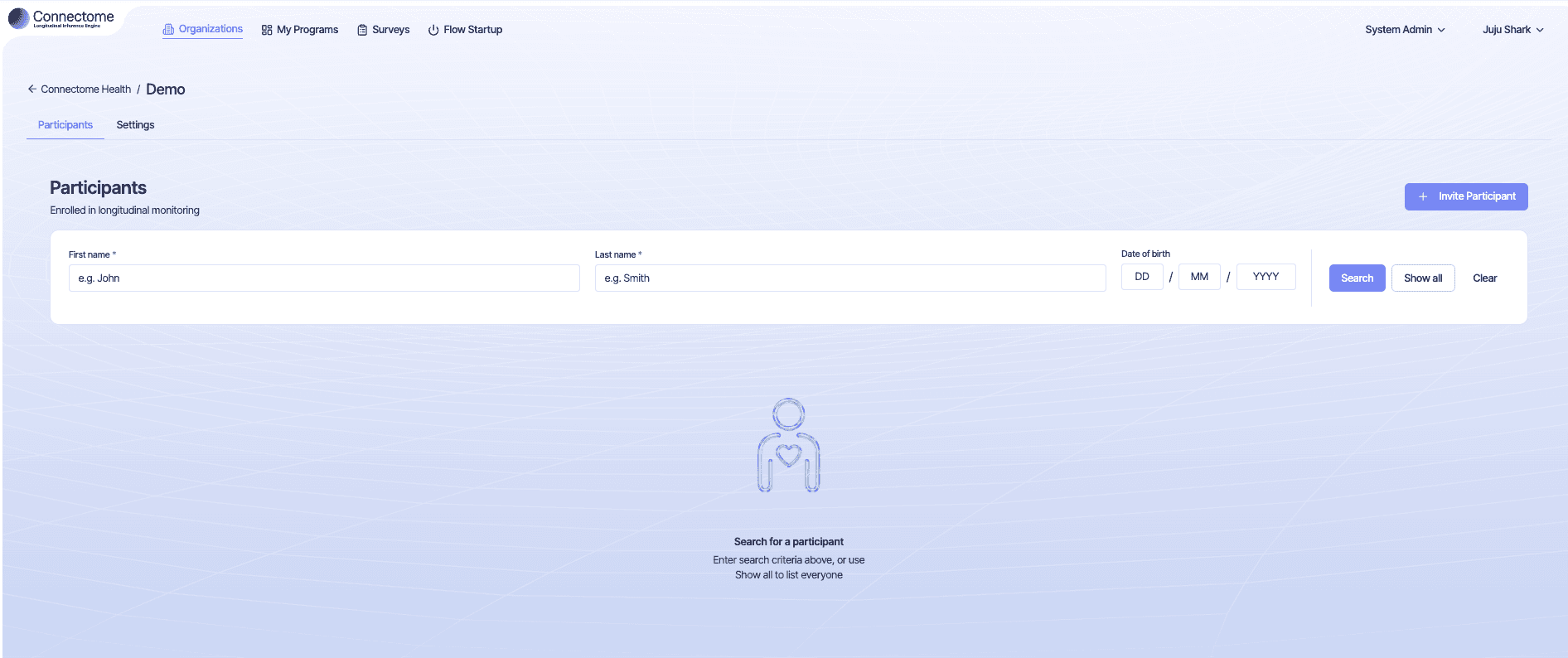
The organisation view: every person’s profile from one login, each read only against themselves.
Three scans before a season or at the start of a programme set each person’s baseline; every scan after is read against it, and the weekly score in the app carries the picture between visits. Formal measurement of a treatment protocol is a research partnership, led by our Chief Scientific Officer.
How to connect your wearable
In Connectome, go to Profile and choose Connect a wearable [menu names, VERIFY with Product].
Pick your device ([supported devices, VERIFY with Product]) and sign in when prompted.
Wear it consistently. About a month of data before a scan is enough for Lifestyle Links to begin personalising to you.
No new device is needed; bring the one on your wrist or finger.
What’s new, at a glance
Personal usual range. Each metric read against your own range from the second scan.
Neural efficiency. A fourth metric: how hard your brain worked for the result.
Lifestyle Links and where to focus. Ninety days of wearable data read against every scan, grouped into four factors, with the factor most strongly linked to your brain named.
The Connectome app. A weekly score that follows your lifestyle between scans. Available now.
Status bar. Scan quality, wearable coverage and personalisation shown above every result.
Events. Log what was going on around a scan; it is marked explained and never re-judged.
Trend per metric. Rising, falling or flat, with a statement of whether the trend is distinguishable from noise.
Stored ranges. Every past result keeps the range it was read against at the time.
The organisation view. Every person’s profile from one login, each read only against themselves.
Coming soon. Cognitive readiness as a further metric.
Available now
The Brain Profile is live for everyone scanning with Connectome. If you have scanned before, your next visit is the one that makes it yours. If you have not, book a scan at our Soho studio: ten minutes in the headset, results about 45 minutes after you leave.
For teams and clinics: book a demo
Brain Profile FAQs
When does a profile become mine?
From your second scan. Your first scan is read against a range built from everyone we have measured, and the status bar says so. From your second scan the range is built from you and tightens with each visit.
Why did my scan land outside my range when I felt fine?
Because a range is meant to be crossed. About one in three scans lands outside by design, even when nothing is wrong. Look at the direction and at what it is linked to. If something was going on, log an Event and the scan is marked explained.
How is my usual range calculated?
From the spread of your own brain responses across your scans, combined with what we know about how much a person’s response normally varies between visits. The range is built to contain your result as often as it says it will, and it narrows as your scans accumulate.
Does the range change my old results?
No. Each result keeps the range it was read against at the time. As your range tightens, new scans are judged against the tighter range; old ones are left as they were.
What does “linked to” mean?
It means association, not cause. Lifestyle Links show which factors in your recent life moved in step with your brain response, and by how much. They do not show that a factor caused the change, and they never attribute a scan to a single Event.
Are the suggestions medical advice?
No. They are general wellbeing suggestions based on your own Lifestyle Links, such as protecting sleep or easing load. They do not involve drugs or supplements and they are not a diagnosis, a treatment or a prescription. If you have concerns about your health, speak to your doctor.
I do not wear a wearable. Does Connectome still work?
Yes. The scan itself needs nothing else. Without wearable data your Lifestyle Links are read against the average participant, and the status bar tells you so. Connecting a device is what makes them about you.
Which wearables can I connect?
[Supported devices, VERIFY with Product]; no device is preferred. Around a month of consistent wear before a scan is enough to begin.
What is neural efficiency?
How hard the brain worked for the result: brain response divided by task performance, shown against your own spread. It is one of the four metrics from every scan and is descriptive only. Two people can post the same score while one cruises and one redlines.
Can a coach, clinician or employer compare me to other people?
No. Every profile is read only against that person. There is no ranking, no leaderboard and no percentile against others, and Connectome cannot be configured to produce one.
Can a clinic or team measure the effect of a programme or treatment?
They can see objective reads before, during and after, each against the person’s own baseline, with the movement and its Lifestyle Links shown. The conclusion is theirs. Formal measurement of a treatment protocol is a research partnership.
How long is a scan?
About ten minutes in the headset, the same tasks and conditions every time.
Is Connectome a medical device?
No. Connectome is a general wellness product. It measures cognitive performance, not pathology, and it does not diagnose, predict or prescribe.
The Brain Profile: measured, personal, and more yours with every scan.
The measures are not intended for diagnostic use. Connectome measures cognitive performance, not pathology, and does not diagnose, predict or prescribe. Suggestions are for general wellbeing and are not medical advice. Research with Imperial College London (LUCID) is a preprint and has not yet been peer reviewed. If you have any concerns about your health, please consult your doctor.
Partner with confidence
If you’re exploring how cognitive intelligence can support performance, health, and decision-making across your organisation, we’d love to talk.

Partner with confidence
If you’re exploring how cognitive intelligence can support performance, health, and decision-making across your organisation, we’d love to talk.
Partner with confidence
If you’re exploring how cognitive intelligence can support performance, health, and decision-making across your organisation, we’d love to talk.
06/10/2026
12 mins
Introducing the Brain Profile: a fingerprint of your unique brain
Juliet Sharkey
Our biggest update yet. A profile that learns you with every scan, Lifestyle Links that show what your brain is linked to, and the Connectome app with a weekly score between visits.
Everything else you track measures your body. Connectome measures your mind. Today we are releasing the Brain Profile: a ten-minute measurement that learns you with every scan, reads your lifestyle against every result, and shows which parts of your life your brain is most strongly linked to, so you know where to focus.
It is built on the same measurement we validated with Imperial College London, and it changes what you get back from every scan. Your results are now read against your own usual range rather than everyone else’s. Your wearable data finally says something about your brain. And a new app keeps the picture live between visits. Whether you scan for yourself at our Soho studio or run a programme for your athletes or clients, the profile works the same way.
“HRV and VO2 max exist for the cardiovascular system. DEXA scans measure muscle mass. Now brain measurement is possible too, and you can’t take care of what you can’t clearly see or reliably measure.”
Lucas Scherdel, Co-founder and CEO, Connectome
Your profile home: each metric today against your own usual range, the region measured, and Lifestyle Links by factor or by brain response.
A profile of you, not a comparison to average
The first question anyone asks about a brain result is “is that good?”. Until now the answer came from a range built from everyone we have measured. From your second scan, it comes from you.
Your usual range is the band your own brain response normally sits in, built from your own scans and tightened with every visit. Each new result lands within it, above it, or below it, and gets a plain-language read: a normal day, generally favourable, or worth a look at what it is linked to. About one scan in three lands outside by design. That is what a range is, not a verdict.
That means a result you can read in one glance, without a norm table. Scan one gives you a starting range. Scan two makes the profile yours. Every scan after that makes it more yours, and every past result keeps the range it was read against at the time, so nothing is re-judged later.
Domains today: each metric against your usual range, with a plain-language read and the trend.
For teams and clinics: every athlete or client is read only against themselves, never against a norm table or each other. A real dip and a bad morning look different before the meeting rather than after the result.
Four metrics from every scan, now with neural efficiency
During a ten-minute scan you complete two short tasks in a headset while the device records how the dorsolateral prefrontal cortex, the part of the brain that plans, focuses and decides, responds. Four metrics come out of it.
Attentional control. Keeping attention where it needs to be and filtering out what does not matter. This is the roll-up metric, so it sits at the top of your profile.
Working memory. Holding information in mind while you use it: the phone number, the plan, the argument you are halfway through making.
Cognitive flexibility. Switching between tasks effectively and making decisions under pressure when the situation changes.
Neural efficiency. New in this release. How hard your brain worked for the result, against your own spread. Two people can post the same score while one cruises and one redlines; this is the metric that tells them apart.
That means you see not just how you did, but how your brain got there. Each metric is shown as a brain response with its own range, next to the task performance it came from, so you can see when the two agree and when they do not.
This scan: brain response, task performance and neural efficiency, each against your own range.
Coming soon: cognitive readiness. A further metric is in development and will be added to your profile when it is ready.
Lifestyle Links: see what’s linked to your brain, and where to focus
Your ring or watch already knows how you slept, how hard your days were and how well you recovered. Until now, none of that told you anything about your mind. Lifestyle Links reads the last ninety days of your wearable data against every scan and shows which factors your brain is most strongly linked to, and by how much.
Lifestyle Links are grouped into four factors: sleep quality (deep, REM and light sleep), sleep interruptions (awake time and how continuous your sleep was), overnight recovery (breathing rate and heart-rate variability while you slept) and daily load (activity, calories burned, steps). For each you see its share, which direction it pushed, and the signal it was read from. View them by lifestyle factor or by brain response, so you can ask either “what is my sleep linked to?” or “what is my working memory linked to?”.
That means one clear place to focus. The factor most strongly linked to your brain is yours, not the average person’s. For one person it is deep sleep. For another, daily load. Your profile names yours and gives you general wellbeing suggestions for supporting it based on your own Lifestyle Links rather than generic advice: protecting deep sleep before a demanding week, say, or easing daily load when your brain is below its range. You choose what to try; your next scan shows whether it was linked to a change. Never drugs or supplements.
Lifestyle Links by factor: the share of your usual range each factor moved with, and the signal it was read from.
Lifestyle Links by brain response: ask “what is my working memory linked to?” instead.
Two things to keep in mind. Links are associations, not causes: they show what your brain response moved in step with, not what caused it to change. And the more consistent your wearable data, the sharper the Lifestyle Links become; about a month of steady wear is enough to begin.
For teams and clinics: one lifestyle focus per person, from their own data, rather than one recovery talk for the squad or one plan for every client. And a way to see whether it is working the next time they scan.
The Connectome app: your brain, your lifestyle, one weekly score
Scans are where the measurement happens. Between them, your lifestyle keeps moving. The Connectome app, available now, learns how your brain response is connected to your sleep and your days, and every week gives you a score that follows your lifestyle.
That means you can see whether the changes you are making are showing before your next scan, not after it. Log an Event when something is going on, watch your weekly score move with your weeks, and arrive at your next scan knowing what to look for. Your scans stay the ground truth; the app keeps your profile live in between.
The Connectome app: your brain, your lifestyle, one score.
Download the Connectome app: [App Store] · [Google Play]
For teams and clinics: every athlete or client gets the weekly score in their own app, so the lifestyle picture stays live between visits and the next scan is read with the context already in place.
Know how much to trust a result before you read it
Some scans deserve more weight than others. Every result in your profile now carries a status bar above it that answers three questions before you look at the number: how good was the scan, how much lifestyle data sits behind it, and how well does the profile know you yet.
That means no silent fallback. If a value is still being read against everyone rather than you, the status bar says so in one line and tells you what will change it. Your profile never shows you a personalised-looking number it cannot stand behind.
The status bar: scan quality, wearable coverage and how personalised your profile is, above every result.
For teams and clinics: a number you can take to a head coach, a medical director or a client knowing exactly how much weight it carries, without adding caveats of your own.
Events: log what was going on around a scan
Life gets in the way of a clean scan. A red-eye flight, a bout of illness, a brutal week, a big night. Events let you record what was happening around a scan so it is read in context.
When a scan lands beyond your range, Connectome asks one question: was something going on? Log an Event and the scan is marked as explained. That means it stays on your timeline with its reason attached, so nobody, including you, over-reads it later. You supply the context; the profile never guesses it, and it never attributes a scan to a cause.
Your timeline: direction over months and years
Every scan sits on a timeline against your usual range as it stood at the time. Toggle the trend line and each metric shows whether it is rising, falling or flat over recent months, and whether that trend is distinguishable from noise.
That means the value compounds. A single scan is a photograph. A timeline shows what a heavy stretch cost you, when you were back, and whether the change you made in the spring did anything. One scan is interesting. Four scans over time is intelligence.
Your timeline: every scan against your usual range as it stood at the time, with Events marked.
For teams and clinics: see what the congested block cost and who has come back; see where a client sat at the start of a programme and where they sit now, and whether the movement is real.
For teams and clinics: the organisation view
Organisations see every athlete’s or client’s own profile from one login, each read only against themselves. There is no ranking, no leaderboard and no percentile against other people, by design, and the product cannot be configured to produce one. Each person sees their data first; access is role-based and logged. This is what makes people willing to be measured, which is what makes the data exist at all.
The organisation view: every person’s profile from one login, each read only against themselves.
Three scans before a season or at the start of a programme set each person’s baseline; every scan after is read against it, and the weekly score in the app carries the picture between visits. Formal measurement of a treatment protocol is a research partnership, led by our Chief Scientific Officer.
How to connect your wearable
In Connectome, go to Profile and choose Connect a wearable [menu names, VERIFY with Product].
Pick your device ([supported devices, VERIFY with Product]) and sign in when prompted.
Wear it consistently. About a month of data before a scan is enough for Lifestyle Links to begin personalising to you.
No new device is needed; bring the one on your wrist or finger.
What’s new, at a glance
Personal usual range. Each metric read against your own range from the second scan.
Neural efficiency. A fourth metric: how hard your brain worked for the result.
Lifestyle Links and where to focus. Ninety days of wearable data read against every scan, grouped into four factors, with the factor most strongly linked to your brain named.
The Connectome app. A weekly score that follows your lifestyle between scans. Available now.
Status bar. Scan quality, wearable coverage and personalisation shown above every result.
Events. Log what was going on around a scan; it is marked explained and never re-judged.
Trend per metric. Rising, falling or flat, with a statement of whether the trend is distinguishable from noise.
Stored ranges. Every past result keeps the range it was read against at the time.
The organisation view. Every person’s profile from one login, each read only against themselves.
Coming soon. Cognitive readiness as a further metric.
Available now
The Brain Profile is live for everyone scanning with Connectome. If you have scanned before, your next visit is the one that makes it yours. If you have not, book a scan at our Soho studio: ten minutes in the headset, results about 45 minutes after you leave.
For teams and clinics: book a demo
Brain Profile FAQs
When does a profile become mine?
From your second scan. Your first scan is read against a range built from everyone we have measured, and the status bar says so. From your second scan the range is built from you and tightens with each visit.
Why did my scan land outside my range when I felt fine?
Because a range is meant to be crossed. About one in three scans lands outside by design, even when nothing is wrong. Look at the direction and at what it is linked to. If something was going on, log an Event and the scan is marked explained.
How is my usual range calculated?
From the spread of your own brain responses across your scans, combined with what we know about how much a person’s response normally varies between visits. The range is built to contain your result as often as it says it will, and it narrows as your scans accumulate.
Does the range change my old results?
No. Each result keeps the range it was read against at the time. As your range tightens, new scans are judged against the tighter range; old ones are left as they were.
What does “linked to” mean?
It means association, not cause. Lifestyle Links show which factors in your recent life moved in step with your brain response, and by how much. They do not show that a factor caused the change, and they never attribute a scan to a single Event.
Are the suggestions medical advice?
No. They are general wellbeing suggestions based on your own Lifestyle Links, such as protecting sleep or easing load. They do not involve drugs or supplements and they are not a diagnosis, a treatment or a prescription. If you have concerns about your health, speak to your doctor.
I do not wear a wearable. Does Connectome still work?
Yes. The scan itself needs nothing else. Without wearable data your Lifestyle Links are read against the average participant, and the status bar tells you so. Connecting a device is what makes them about you.
Which wearables can I connect?
[Supported devices, VERIFY with Product]; no device is preferred. Around a month of consistent wear before a scan is enough to begin.
What is neural efficiency?
How hard the brain worked for the result: brain response divided by task performance, shown against your own spread. It is one of the four metrics from every scan and is descriptive only. Two people can post the same score while one cruises and one redlines.
Can a coach, clinician or employer compare me to other people?
No. Every profile is read only against that person. There is no ranking, no leaderboard and no percentile against others, and Connectome cannot be configured to produce one.
Can a clinic or team measure the effect of a programme or treatment?
They can see objective reads before, during and after, each against the person’s own baseline, with the movement and its Lifestyle Links shown. The conclusion is theirs. Formal measurement of a treatment protocol is a research partnership.
How long is a scan?
About ten minutes in the headset, the same tasks and conditions every time.
Is Connectome a medical device?
No. Connectome is a general wellness product. It measures cognitive performance, not pathology, and it does not diagnose, predict or prescribe.
The Brain Profile: measured, personal, and more yours with every scan.
The measures are not intended for diagnostic use. Connectome measures cognitive performance, not pathology, and does not diagnose, predict or prescribe. Suggestions are for general wellbeing and are not medical advice. Research with Imperial College London (LUCID) is a preprint and has not yet been peer reviewed. If you have any concerns about your health, please consult your doctor.
Partner with confidence
If you’re exploring how cognitive intelligence can support performance, health, and decision-making across your organisation, we’d love to talk.
Partner with confidence
If you’re exploring how cognitive intelligence can support performance, health, and decision-making across your organisation, we’d love to talk.
Partner with confidence
If you’re exploring how cognitive intelligence can support performance, health, and decision-making across your organisation, we’d love to talk.